What it does
Turns one clear photo into a likely type, era, material, and value read.
Photo-first antique identifier
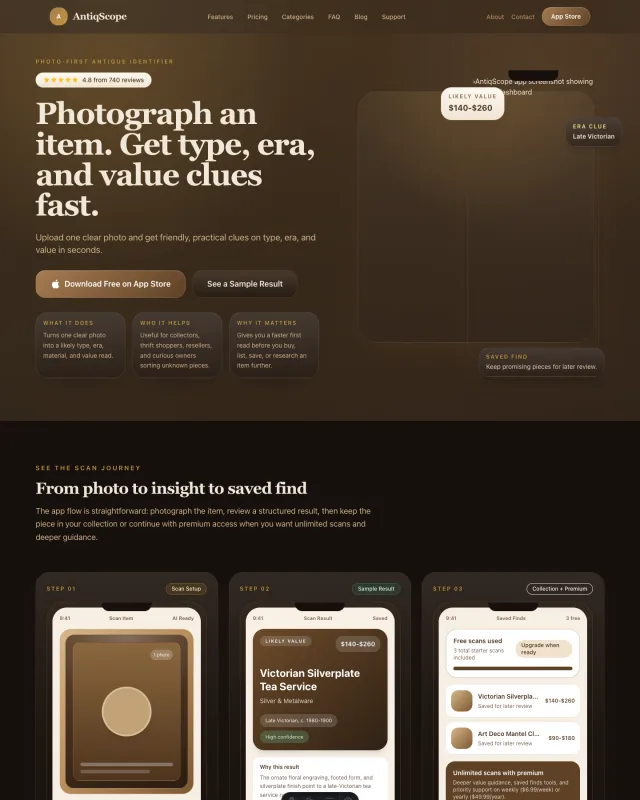
Upload one clear photo and get friendly, practical clues on type, era, and value in seconds.
What it does
Turns one clear photo into a likely type, era, material, and value read.
Who it helps
Useful for collectors, thrift shoppers, resellers, and curious owners sorting unknown pieces.
Why it matters
Gives you a faster first read before you buy, list, save, or research an item further.
Saved Find
Keep promising pieces for later review.
See the scan journey
The app flow is straightforward: photograph the item, review a structured result, then keep the piece in your collection or continue with premium access when you want unlimited scans and deeper guidance.
Best first shot
Whole item, front-facing
Optional second shot
Marks, base, or damage
Start with one clear photo of the item front, then add a close-up if you want extra context on marks, wear, or details.
Victorian Silverplate Tea Service
Silver & Metalware
Why this result
The ornate floral engraving, footed form, and silverplate finish point to a late-Victorian tea service rather than sterling.
Caution before you price it
Silverplate wear, dents, and missing pieces can reduce value quickly.
AntiqScope returns a probable type, era, material hints, confidence band, and a practical value range in one readable result.
Free scans used
3 total starter scans included
Victorian Silverplate Tea Service
Saved for later review
Art Deco Mantel Clock
Saved for later review
Unlimited scans with premium
Deeper value guidance, saved finds tools, and priority support on weekly ($6.99/week) or yearly ($49.99/year).
Use the 3 free scans to test promising pieces, then subscribe for unlimited scans, deeper value guidance, and saved finds tools.
The first result is meant to be immediately useful: identify the likely type, read the era and material clues, and check whether the value range makes the item worth more attention. When a piece looks promising, save it and keep building a personal bank of finds instead of treating every scan like a one-off guess.
Who it helps and why it is useful
AntiqScope is for the moment when an item is in front of you and you need enough structure to decide whether to buy it, research it further, save it, or move on.
Who it helps
Use a scan when a booth, thrift rack, or estate sale piece looks promising and you need a quick first read.
Who it helps
Spot pieces worth a second look and keep value clues nearby before you build a listing or make an offer.
Who it helps
Get oriented when you are handling inherited pieces, attic finds, or unlabeled objects that need context fast.
What each result gives you
Turn one clear photo into a confident first read on what you are holding.
Get a practical value range to guide your next research move.
Receive warm, readable insights in seconds when timing matters.
See likely type, era, and style clues without digging through tabs first.
Keep promising pieces together so you can revisit them when ready.
Get practical caution notes before you buy, sell, or overprice a piece.
The result is built to answer the first question quickly: what type of antique or collectible this most likely is.
Era, style, and material clues help you decide whether a piece deserves more research, more photos, or expert appraisal.
Saved finds turn a one-off scan into collector-style usage, so promising pieces stay organized instead of disappearing into screenshots.
Examples, proof, and grounded feedback
AntiqScope is built for first-pass antique and collectible research. The examples below show the kinds of pieces people scan, what the result may help with, and how users tend to use that output in practice.
Examples gallery
Why people scan it
Check whether an ornate service looks like late-Victorian silverplate or a later decorative piece.
What the result may help with
Likely type, era direction, visible material clues, and whether it is worth checking hallmarks and condition more closely.
Why people scan it
Use the first scan to sort broad era and style signals before you start comparing base marks by hand.
What the result may help with
A faster way to narrow likely region, decorative style, and the next detail photo that matters.
Why people scan it
Get oriented on period style when an estate sale item looks promising but unlabeled.
What the result may help with
Quick clues on style period, visible materials, and whether restoration or missing parts may matter to value.
Why people scan it
Decide whether a flea market find deserves a second photo, a saved scan, or a deeper listing check.
What the result may help with
A practical first read before you spend more time on maker details, accessories, or sold comps.
Testimonials
The strongest feedback is usually specific: where the scan saved time, where it pointed to a better next step, and where users still chose to verify more carefully.
"Useful for separating pieces worth a closer look from ones I can leave behind. I still verify marks, but it gives me a fast first pass."
Clara W.
Estate sale buyer
"The value band is most helpful when it tells me whether a thrift find deserves a second photo and more research before I price it."
Ben H.
Weekend reseller
"I used it on inherited ceramics. It did not replace follow-up reading, but it helped me narrow the likely era and what details to inspect next."
Iris M.
Family collections sorter
Use 3 free starter scans first. After that, choose weekly or yearly unlimited access in the App Store.
Starts after your 3 free scans are used.
That's just $4.16/mo
Starts after your 3 free scans are used.
Two subscription options only: weekly and yearly unlimited access. Billing, renewal, and cancellation are managed by Apple.
Everything you need to know about AntiqScope.
Results are estimates based on visual data and similar item references.
Yes, cards, coins, and many collectibles are supported.
Yes, you can use 3 total free scans before subscribing.
No, values are guidance only and not a financial guarantee.
Yes, cancel from Apple ID subscription settings.